1 · What is ESPuino?
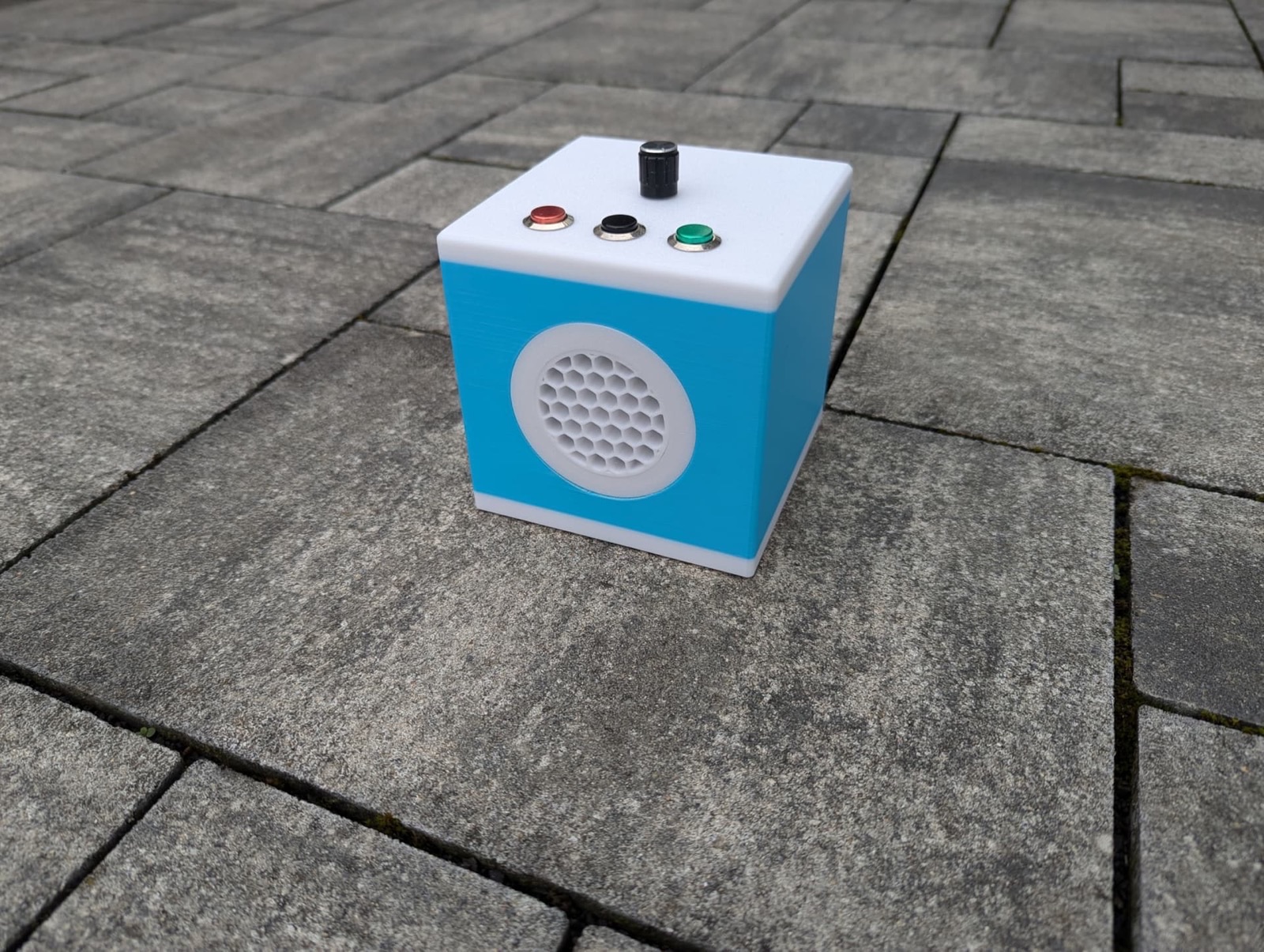 This is roughly what a finished ESPuino can look like – how colorful, big, and individual yours turns out is entirely up to you.
The basic idea
ESPuino is a self-built, RFID-controlled audio player: you place a card on it, and an audio drama, an audiobook, or a playlist starts playing. Take the card off, or place a different one on, and the content changes. It's an interaction concept even the youngest children grasp immediately – and that's exactly what ESPuino was designed for in the first place: a robust, child-friendly audio box that needs no screen, no account, and no cloud.
The name gives away its origins: at its heart sits a microcontroller from the ESP32 family. Around that core, an astonishingly complete device has grown over the years – with an amplifier, battery charging, an LED display, buttons, and a rotary knob. Even so, ESPuino remains an open DIY and self-build project: the source code is free, the hardware is documented, and you decide for yourself how big, how loud, and how colorful your box turns out – just how varied that can be is shown by the gallery „Zeigt her eure ESPuinos" (German-language forum).
One point is important to understand, because it explains a few things later on: nothing is ever written to the RFID cards themselves. ESPuino only reads a card's unique number (its ID) and keeps track internally of which content belongs to it. So you can use ordinary, off-the-shelf RFID cards, chips, or stickers – specifically the ISO-14443 standard, and (only with the PN5180 reader) ISO-15693 – and reassign the very same card to different content at any time.
What does an ESPuino consist of?
This is the question asked most often – so here's an overview right at the start. The following list describes a typical ESPuino based on the Complete board, which is what this handbook focuses on. Much of this already comes pre-assembled on the Complete board; you only need to add the parts that depend on your own preferences (which speaker, which battery, which enclosure).
| Component | What it's for, and what you should know |
|---|---|
| Complete board | The foundation. It already integrates an ESP32-WROVER, amplifier, charge controller, voltage monitoring, port expander, and SD slot. |
| RFID reader | Reads the cards. You can choose between the affordable RC522 or the more capable PN5180. |
| microSD card | Stores your content. Must be formatted as FAT32; 32 to 64 GB is usually plenty. |
| Neopixels | Addressable LED(s) for status and progress – most commonly a ring, though a strip or even a single LED works too. Formally optional, but in practice hard to do without: they're the central feedback channel (connectivity, progress, battery, errors …). Strongly recommended. |
| Speaker | For sound output. Headphones are optionally possible via a separate headphone board. |
| Rotary encoder + up to 5 buttons | Controls at the device itself; both are optional. The default layout provides for three buttons plus the rotary encoder. |
| Battery | For mobile operation (LiFePO4 or LiPo, each with a protection circuit). Also optional – ESPuino runs fine on a USB power supply alone. Details in chapter 4 · The battery. |
| Enclosure | Usually 3D-printed. You'll find a ready-made reference design in chapter 6 · The enclosure. |
A more detailed version of this is also available in the forum FAQ (German-language).
The ESPuino ecosystem
ESPuino is more than a single repository, and it helps to know how the pieces fit together – that way you'll know later where to find what:
- ESPuino is the firmware, i.e. the software that runs on the device. It's the subject of this handbook.
- ESPuino-Firmware provides ready-built firmware releases that you can flash without compiling anything yourself.
- MediaHub is an optional add-on component for managing the card assignments of several ESPuinos centrally (see chapter 11).
- The forum is the place for questions, announcements, and exchange with others. This handbook consolidates the knowledge; the discussion lives on in the forum.
A look back: the development lineage
ESPuino has grown over several years, and it's worth placing that briefly in context – not least because you'll still run into older builds in the forum. It started with genuine DIY builds, where individual modules were plugged together and wired by hand. From there came stripboard builds, and later carrier boards that housed ready-made developer boards. The direct predecessor of today's Complete is the mini4L, which used a purpose-built ESP32 board plugged into it.
The Complete is the logical continuation of that line: functionally, it offers essentially the same as the mini4L, but combines everything (apart from the headphone board) onto a single board. That lowers cost and considerably simplifies assembly. That's exactly why this handbook centers on the Complete; the mini4L still appears as its most recent predecessor, but only where it differs from the Complete (chapter 16). We don't cover older stages.
Small glossary
A handful of terms keep coming up throughout the handbook. You don't need to memorize them – just look them up here whenever you're unsure:
| Term | Meaning |
|---|---|
| RFID | A contactless card or tag used to start a piece of content. ESPuino only reads the ID; it never writes anything to the card. |
| NVS | "Non-Volatile Storage" – the ESP32's internal memory, where settings and card assignments live. A regular firmware update does not overwrite it, so your settings survive. |
| HAL | "Hardware Abstraction Layer" – selects, at compile time, which board (with which pins) the firmware is built for; often also called the platform (e.g. complete, lolin_d32_pro_sdmmc_pe, lolin_d32_pro). |
| Neopixel | Addressable LED(s) used for status and progress display. Often arranged as a ring; ideally the LED count is divisible by four, since several animations are designed around that. |
| Deep sleep | The power-saving deep sleep that ESPuino enters after a period of inactivity – or when you "switch it off". A true, complete shutdown (power fully removed) isn't provided for by default but is possible; it comes with a somewhat longer boot time on the next power-up. |
| Playmode | The playback mode of a card (single title, audiobook, whole folder …). All modes in detail: chapter 8 → Playback modes. |
| Modification card | A card that doesn't start any content but triggers a function instead – a sleep timer, for example. All actions in detail: chapter 8 → Modification cards. |
| LiPo | Lithium-polymer battery. Nominal voltage ~3.7 V, charge cutoff 4.2 V. High energy density (lots of capacity per size/weight), but more sensitive and less durable. |
| LFP | Lithium iron phosphate battery (LiFePO₄). Nominal voltage ~3.2–3.3 V, charge cutoff ~3.6 V. Very safe and durable, but lower energy density (less capacity) and lower voltage. |