16 · Existing devices: mini4L
The mini4L is the direct predecessor of the Complete. It's no longer sold, but remains fully supported – so if you own one, you're in the right place. So this handbook doesn't explain everything twice, this chapter deliberately limits itself to the differences from the Complete. Everything not mentioned here – and that's by far the largest part, from operation to the web interface – works on the mini4L exactly as described in the other chapters.
What sets the mini4L apart
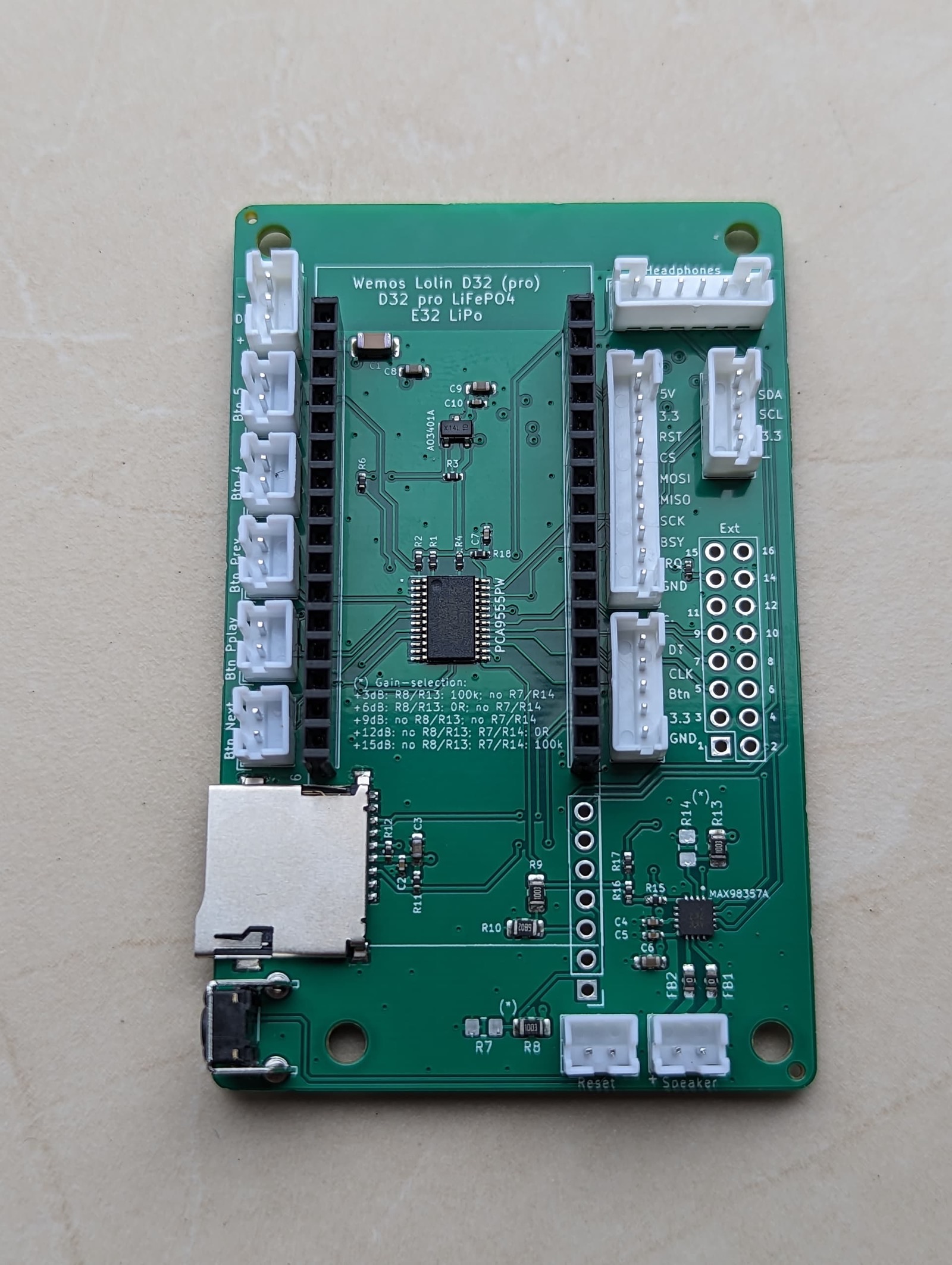
Unlike the Complete, which combines everything on one board, the mini4L consists of two parts: a
carrier board and a plugged-in developer board on top of it (a purpose-built D32 Pro board, see
forum #1109, German-language).
The firmware build target is accordingly called lolin_d32_pro_sdmmc_pe. It's introduced and
discussed in forum #1661 (German-language).
Pinout and SD-MMC
In practice, the actual ESP32 GPIOs are largely identical to the Complete: I²S on 25/27/26, the RFID SPI lines on 21/18/23/19, RFID_BUSY on 33 and RST on 22, the encoder on CLK 34 / DT 39, the LED on 12, wakeup and port-expander interrupt on 36, battery measurement on 35, and the IR receiver on 5. The SD card runs in SD-MMC mode (1-bit) via CLK 14, CMD 15, and D0 2. The Next, Prev, and Play/Pause buttons also sit on port-expander channels 102, 100, and 101, just as on the Complete.
The differences are limited to a few port-expander channels:
| Signal | mini4L | Complete |
|---|---|---|
Amplifier enable (GPIO_PA_EN) |
PE 108 | PE 113 |
| Encoder button | PE 103 | PE 105 |
| Button 4 / 5 | PE 104 / 105 | PE 103 / 104 |
Headphone detection (HP_DETECT) |
PE 107 | PE 108 |
| Power (peripheral cutoff) | PE 115 | PE 114 |
On the mini4L, the PN5180 IRQ is disabled by default (value 99); for LPCD, you'd set it to
GPIO 32.
Firmware and operation
You build the firmware with the lolin_d32_pro_sdmmc_pe target – otherwise
chapter 13 applies unchanged. In everyday use, the most important
difference ultimately comes down to a hardware detail: on the mini4L, power supply runs through a
linear regulator (LDO) instead of the Complete's buck/boost regulator. What that means is explained
in detail in
chapter 3 → power supply.
Operation and the web interface are fully identical to the Complete.